- EXPERIENCED LAW FIRM IN TOLEDO, OH
- (419) 662-3100



Mediation vs. Arbitration vs. Litigation

Understanding Ohio’s Termination Laws
October 3, 2023
Trusts & Beneficiaries in Ohio
October 23, 2023
Business Dispute Resolution
Mediation vs. Arbitration vs. Litigation
Mediation, arbitration, and litigation are three different methods for resolving a legal dispute.
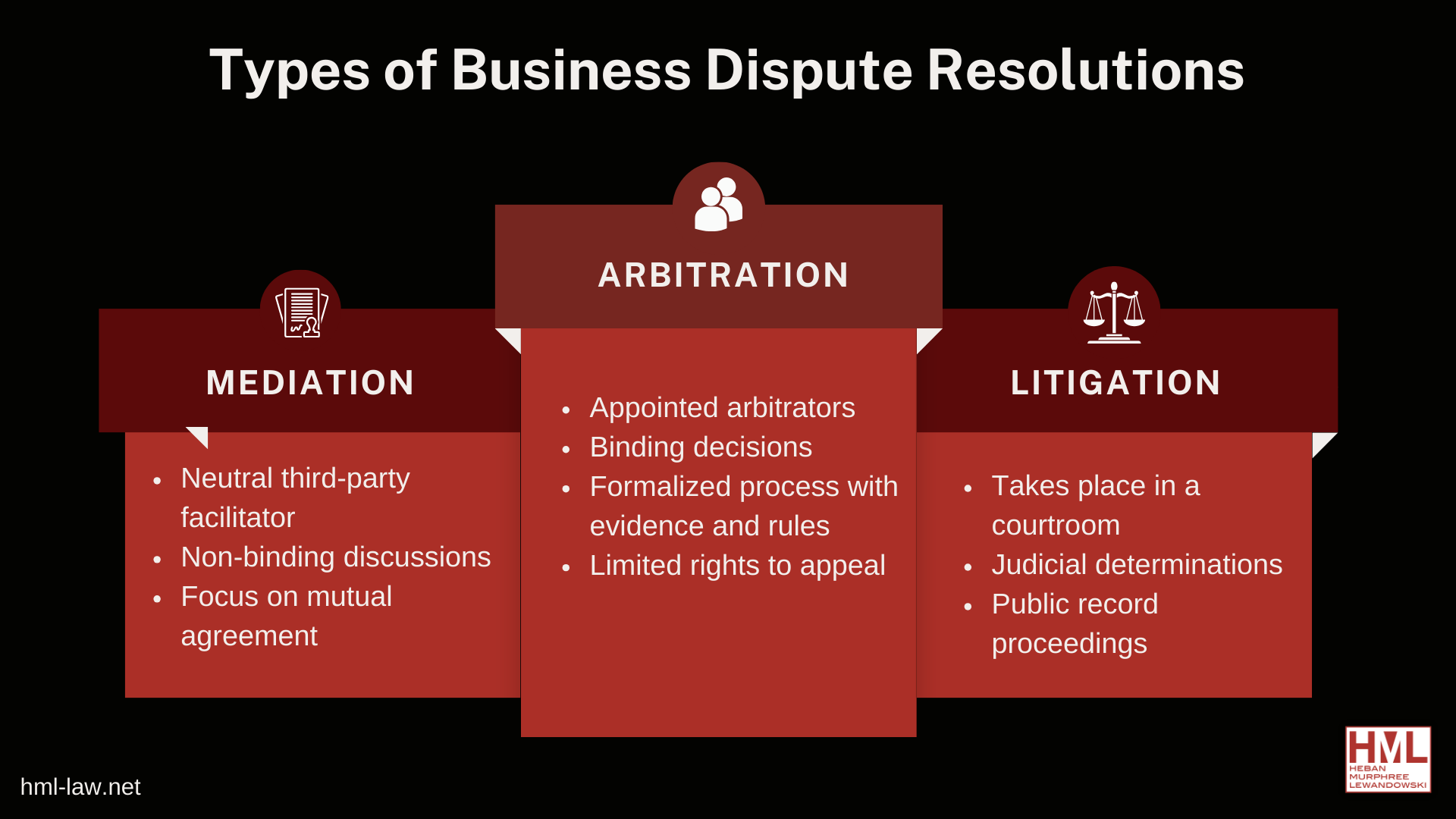
Mediation uses a neutral facilitator who helps the parties negotiate their own voluntary agreement. Arbitration uses a private decision-maker who hears the evidence and usually issues a binding award. Litigation places the dispute in court, where a judge or jury decides the outcome under formal procedural and evidentiary rules.
The right option depends on the parties’ contract, the need for confidentiality, the amount at stake, available evidence, urgency, appeal rights, cost, and whether the parties need a court order.
When a contract, business, ownership, or property disagreement becomes contested, our civil and commercial litigation attorneys can evaluate negotiation, mediation, arbitration, and court options.
Mediation, Arbitration, and Litigation Compared
Each method resolves disputes differently. The best fit depends on the parties’ agreement, objectives, evidence, timing, and need for a binding decision.
| Factor | Mediation | Arbitration | Litigation |
|---|---|---|---|
| Who decides? | The parties | Arbitrator or panel | Judge or jury |
| Binding result? | Only when an agreement is reached and documented | Usually binding if required by agreement | Court judgment is binding |
| Privacy | Generally private | Generally private | Court filings and proceedings are often public |
| Formality | Lowest | Moderate | Highest |
| Procedure | Flexible negotiation | Controlled by contract and provider rules | Governed by formal court and evidentiary rules |
| Appeal rights | N/A (voluntary settlement) | Usually very limited | Available subject to appellate rules |
| Cost & timing | Often lower cost and faster | Often moderate time and expense | Can be the most time-consuming and costly |
| Best suited for | Preserving relationships & custom settlements | Private binding decisions or contract clauses | Court authority, injunctive relief, or precedent |
Mediation: The Collaborative Approach
Mediation gives disputing parties an opportunity to work toward a voluntary resolution with help from a neutral mediator. The mediator does not decide who wins. Instead, the mediator helps the parties identify issues, exchange proposals, evaluate risk, and determine whether a negotiated agreement is possible.
Mediation can be particularly useful when the parties want more control over the result or hope to preserve an ongoing business, ownership, or contractual relationship.
● Potential Advantages
- Cost-efficiency: Mediation often requires less time and expense than full litigation.
- Speed: A mediation can often be scheduled and completed sooner than a court trial.
- Relationship preservation: A negotiated solution allows business partnerships to continue.
- Confidentiality: Mediation discussions remain generally private.
● Potential Drawbacks
- No guaranteed resolution: The parties are not required to reach an agreement. If mediation fails, arbitration or litigation may still be necessary.

Arbitration: A Private Decision-Making Process
Arbitration is more formal than mediation because an arbitrator or panel hears the parties’ positions and issues a decision. The process may involve written submissions, document exchange, testimony, hearings, and legal arguments.
Arbitration procedures are often established by a contract and the rules of the arbitration provider. Depending on the agreement and applicable law, the award may be binding, and appeal rights may be significantly more limited than in court.
● Potential Advantages
- Timing: Arbitration may move more quickly than traditional litigation.
- Privacy: Arbitration generally occurs outside the public court system.
- Finality: A binding award can bring a dispute to a conclusion without years of appellate litigation.
● Potential Drawbacks
- Cost: Provider fees, arbitrator fees, and discovery can still make arbitration expensive.
- Limited appeals: Challenging an award is significantly restricted compared to court appeals.
- Arbitrator selection: The method of panel selection is critical to fairness.
Litigation: Resolving a Dispute in Court
Litigation places the dispute in the court system. The parties must follow formal procedural rules, comply with court deadlines, exchange information through discovery, address motions and evidentiary issues, and, if the dispute does not settle, present the case to a judge or jury.
Litigation may be necessary when a party needs a court order, compulsory discovery, injunctive relief, enforcement authority, formal adjudication, or access to appellate review.
● Potential Advantages
- Formal procedure: Court rules strictly govern claims, discovery, evidence, and trial.
- Appeal rights: Judicial decisions can be reviewed by appellate courts.
- Enforceable decisions: Courts issue directly enforceable judgments and injunctions.
● Potential Drawbacks
- Time: Court dockets can take longer than mediation or arbitration.
- Cost: Extensive discovery, motions, and trial prep increase legal expense.
- Adversarial nature: Formal court battles can severely strain ongoing relationships.

Pre-Mediation Agreements and Ground Rules
The parties can establish expectations before mediation begins. Depending on the dispute and the mediator, preliminary agreements may address confidentiality, mediator selection, scheduling, information exchange, participation, and other practical details.
Clarifying these issues in advance can reduce procedural disagreements and allow the mediation session to focus on the underlying dispute.
Confidentiality
Establish expectations concerning the privacy of mediation discussions and materials.
Mediator Selection
Identify how the mediator will be chosen and any qualifications the parties consider important.
Time Frame
Establish scheduling expectations and the amount of time allocated for the process.
Participation & Authority
Identify who should attend and ensure participants have sufficient authority to settle.
Other Factors to Consider
No dispute-resolution method is automatically best for every matter. The appropriate choice depends on the parties’ agreement, the nature of the conflict, the available evidence, and the result each party needs.
The number of parties, the amount of evidence, the legal issues, and the need for formal discovery affect practicality.
Consider whether you need a negotiated agreement, a private binding decision, or an enforceable court judgment.
Expected duration, attorney time, filing fees, arbitrator fees, and discovery expenses vary substantially.
Businesses concerned about public records or proprietary data value private dispute-resolution.
Arbitration offers very narrow grounds for challenge compared to court litigation, while mediation yields no decision without consensus.
A lawsuit is necessary when a party requires compulsory discovery, injunctions, or judicial enforcement powers.
When a Business or Property Dispute Becomes Contested
When a contract, business, ownership, or property disagreement becomes contested, our civil and commercial litigation attorneys can evaluate negotiation, mediation, arbitration, and court options.

Need Legal Help With an Ohio Dispute?
Mediation, arbitration, and litigation offer different ways to resolve a dispute. HML can review the governing agreement, available evidence, deadlines, business considerations, and practical options before you decide how to proceed.